Alberta's iGaming Launch in 2026
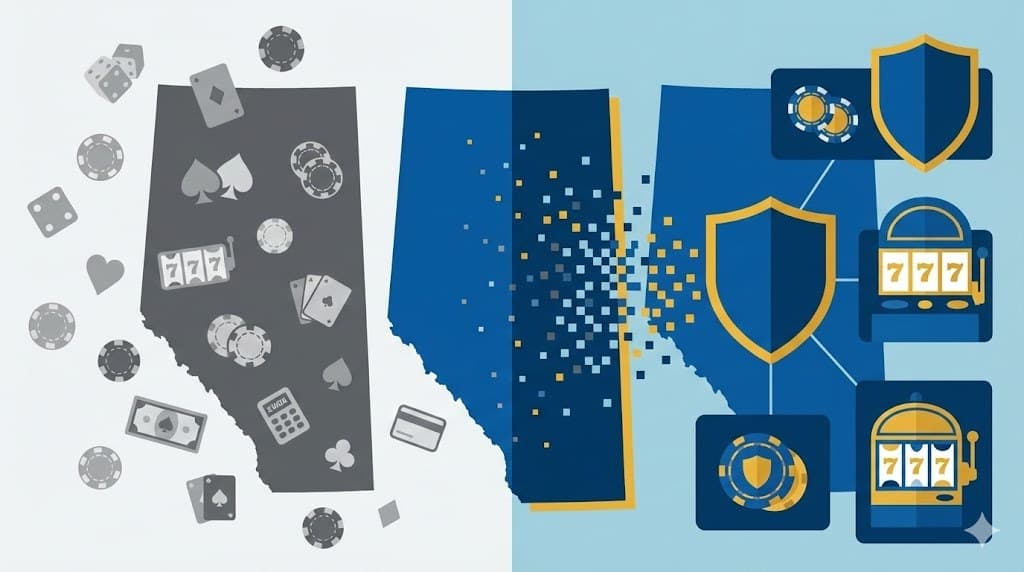
Alberta is becoming Canada's second regulated online gambling market. The iGaming Alberta Act passed in May 2025, and Minister Dale Nally now projects an early 2026 launch. For Albertans currently using offshore sites – and that's the vast majority of them – this changes everything.
The Numbers Behind Alberta's Grey Market Problem
A June 2025 survey by Ipsos and the Canadian Gaming Association found that 77.3% of Alberta gamblers exclusively used unregulated websites over a three-month period. Only 10.4% reported using Play Alberta exclusively.
That's not a typo. The province's only legal option attracts barely one in ten gamblers.
Independent data from H2 Gambling Capital suggests Play Alberta has never captured more than 30% of Alberta's total online gambling market. As of fiscal year 2024, it sits at just 28%. The remaining 70%+ flows to offshore operators who pay no provincial taxes and answer to no Alberta regulator.
Perhaps more troubling: 55% of Albertans using unregulated websites believed they were playing on regulated platforms. They don't even know they're gambling grey.
What Ontario Proved Is Possible
Ontario's regulated market opened in April 2022. Three years later, the results are hard to argue with.
Ontario's iGaming market generated CA$3.2 billion in gross gaming revenue during fiscal year 2024-25, a 32% increase over the previous year. Total wagers reached CA$82.7 billion.
The market now includes 49 operators running 84 gaming sites , ranging from international names like bet365 and BetMGM to the government-owned OLG platform. Deloitte's economic impact study highlighted that Ontario's iGaming market contributed an estimated $1.24 billion in gaming and tax revenues to federal, provincial, and municipal governments while sustaining nearly 15,000 full-time equivalent jobs.
Before regulation, offshore gambling made up roughly 75% of Ontario's market. Now, H2 projects 95% of activity occurs on regulated platforms in fiscal 2025. That's the channelization rate Alberta is hoping to replicate.

How Alberta's System Will Work
Alberta is adopting Ontario's dual-agency model. Alberta Gaming, Liquor and Cannabis (AGLC) will serve as the regulatory authority, while the newly created Alberta iGaming Corporation (AiGC) will manage contracts and market operations – essentially the same structure Ontario uses with the AGCO and iGaming Ontario.
Minister Dale Nally confirmed in a statement that conversations are ongoing and cover topics including the regulatory framework, player safety measures like system-wide self-exclusion, and the registration process. An interim CEO will soon be appointed to complete the work necessary to establish the AiGC.
Private operators will sign agreements with the AiGC to legally offer sports betting and casino games to Albertans. Players in Ontario have access to sportsbooks like DraftKings, FanDuel, BetMGM, PointsBet, Caesars, and BetRivers. Many of these operators are expected to pursue licenses to operate in Alberta as well.
Self-Exclusion From Day One
Here's something Alberta is getting right that Ontario didn't: the province's bill stipulates that a centralized self-exclusion tool will be implemented from launch. The Alberta system will include not just all online gaming sites popular in Canada but also land-based casinos and racing entertainment centres.
Ontario, by contrast, is still building its centralized self-exclusion system more than three years after launch. iGaming Ontario only selected IC360 and IXUP to develop the province's first centralized self-exclusion system in August 2024 , with the project still in development.
For players concerned about their gambling habits, Alberta's approach offers stronger protections from the start.

The Decisions Still to Come
Several key details remain undetermined. Minister Nally stated he would return to cabinet colleagues in the fall to discuss advertising standards and tax rates.
The advertising question is particularly contentious. Nally even asked attendees at the Canadian Gaming Summit whether they'd prefer only retired athletes to participate in iGaming advertising or if all athletes should be allowed. Ontario banned athletes, influencers, and celebrities from gambling promotion – Alberta could follow suit or take a more permissive approach.
The timeline has been pushed back from an original October 2025 target. A press secretary for Minister Nally told Canadian Gaming Business they anticipate regulations could be finalized soon, with more details about the Alberta iGaming Corporation coming in early 2026.
What This Means for Alberta Players
For the estimated 90% of online gamblers currently using grey market sites, regulated gambling in Alberta brings practical benefits:
Recourse when things go wrong. Disputes with offshore operators leave players with no real options. Licensed operators must answer to provincial regulators.
Verified fairness. Regulated sites face oversight on their random number generators, payout rates, and game integrity.
Self-exclusion that works. A single registration will block access across all licensed platforms – something grey market sites have no incentive to honor.
Money stays local. Ontario's regulated market contributes directly to provincial priorities such as infrastructure, healthcare, and education. Alberta will collect similar revenues instead of watching them flow offshore.
Political Complications
Minister Nally is one of numerous Alberta MLAs facing a recall petition. Elections Alberta approved the petition, and the signature collection process runs until late February. Political distractions could slow progress, though the legislation is already passed.
Some operators have begun adjusting their expectations. PointsBet CEO Sam Swanell suggested in August that he expected a second-quarter 2026 launch, while Super Group indicated the second half of 2026 was more realistic.
The Bigger Picture
Minister Nally has been clear about the goal: "We're not trying to grow the market or create new gamblers in Alberta. Our goal is to implement a regulated market for private companies to legally operate online gambling sites where safeguards are in place, consumers are protected, and market integrity and social responsibility are top of mind."
That's the right framing. The gambling is already happening – the question is whether it happens under provincial oversight or beyond anyone's control.
As Nally put it at the Canadian Gaming Summit: "We know we have Albertans gambling online and we have a fiduciary responsibility to all Albertans to make sure that when they gamble online, they can do so safely and in a more responsible fashion."
Ontario proved the model works. Alberta is betting it can do even better – with stronger responsible gambling protections from launch and a regulatory framework informed by three years of watching its eastern neighbor work out the kinks.
For players looking beyond Alberta, those interested in top rated casinos operating under strict licensing conditions can find options that already meet rigorous standards.