Brazil's $3 Billion Betting Experiment

Brazil flipped the switch on January 1, 2025. After decades in regulatory limbo, the world's fifth-largest population finally got legal online betting. Twelve months later, the numbers tell a story that few predicted - R$17.4 billion in revenue, 17.7 million active bettors, and a government scrambling to handle unintended consequences.
The transformation wasn't smooth. It involved blocking 25,000 illegal websites, banning 54 million welfare recipients from gambling, and watching international operators spend hundreds of millions to grab market share. Here's what actually happened.
The regulator built a surveillance machine
The Secretaria de Prêmios e Apostas (SPA) didn't just create a licensing framework - it built one of the most comprehensive gambling monitoring systems anywhere. The SIGAP platform processes 500 million records daily from licensed operators, tracking everything from individual bets to suspicious transaction patterns.
Secretary Regis Dudena's team moved aggressively from day one. By June 2025, the SPA had opened 66 supervisory proceedings against 93 operators, sanctioning 35 of them. Working with Anatel (Brazil's telecom regulator) and the Central Bank, the agency created a three-front enforcement approach: block site access, cut payment flows, and penalize advertising violations.
The R$30 million license fee - roughly $5-6 million depending on exchange rates - kept small operators out. Add the R$5 million financial reserve requirement and mandatory 20% Brazilian shareholding for foreign companies, and the barrier to entry became substantial. At launch, only 14 operators held definitive licenses, though 52 more operated under provisional authorization.
The .bet.br domain created instant visibility
Brazil's most distinctive regulatory choice was mandating .bet.br domains for all licensed operators. The logic was simple: consumers can immediately identify legal platforms by checking the URL. No .bet.br, no license.
The implementation hit snags. Some operators struggled with technical migration. Banks had trouble recognizing new domain-based accounts. Google's algorithms temporarily buried the fresh .bet.br sites in search results. And research showed 78% of Brazilians still can't reliably distinguish legal from illegal platforms - suggesting the domain distinction needs more time to achieve its consumer protection goals.
Still, the system provides a verification mechanism that most jurisdictions lack. Anyone can check an operator's status through the SIGAP public portal, and financial institutions now reference this database when processing payments.
International operators paid premium prices for market access
Flutter Entertainment made the biggest bet. The FanDuel and Betfair parent company paid $350 million for 56% of NSX Group, acquiring Betnacional, MrJack.bet, Pagbet, and Betpix in a single deal. Combined with Betfair Brazil, Flutter created a local powerhouse expecting $220 million in 2025 revenue.
The company's commitment went beyond acquisition. Flutter chose to shut down PokerStars casino and sportsbook products entirely rather than pursue separate licensing - accepting roughly $10 million in EBITDA loss to simplify its Brazilian structure.
Market leadership quickly consolidated around two brands. Betano (owned by Kaizen Gaming) captured 23% market share. Bet365 grabbed 20%. Both secured provisional licenses initially, converting to full authorization by February 2025. Other major internationals including Betsson, Caesars, Stake, and Novibet joined the licensed market through similar pathways.
Local operators held their ground too. KTO, EstrelaBet, Galera.bet, and Betnacional compete for the remaining share, leveraging brand recognition built during the gray market years.
The tax burden reached 50-58% of gross profits
Brazil's operators discovered that the headline 12% GGR tax was just the beginning. Within six months, fiscal pressure pushed rates to 18%, with legislation proposing 24%. Layer on corporate income tax (15% plus 10% surcharge), social contributions (9%), PIS/COFINS (9.25%), municipal service tax (2-5%), and monthly inspection fees ranging from R$54,419 to R$1.9 million, and the total effective burden lands between 50-58% of gross profits.
Players face their own tax obligation - 15% on net winnings above approximately R$2,824. The government allocated these revenues across specific purposes: 36% to sports programs, 28% to tourism, 14% to public security, 10% each to education and social security, and 1% to gambling harm prevention.
The first nine months generated R$6.85 billion in operator taxes plus R$2.01 billion in initial license fees. Real money, but industry groups warn the escalating burden pushes players toward untaxed offshore alternatives.
Blocking 25,000 domains barely scratched the surface
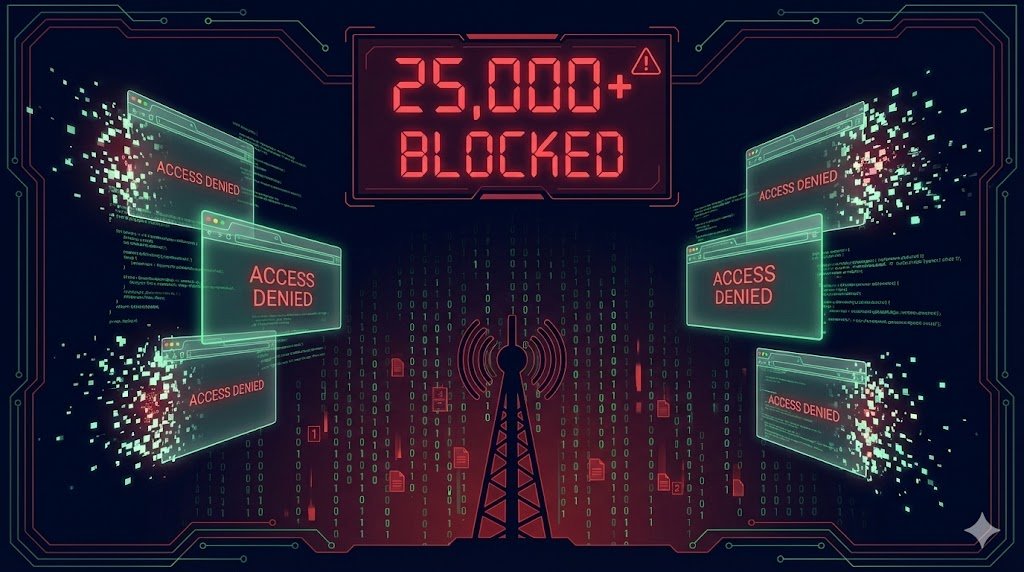
The enforcement campaign started months before the regulated market launched. First 2,040 domains blocked in October 2024. Then 1,400 more. Then 1,812. By year-end 2025, the cumulative total exceeded 25,000 blocked gambling domains.
The technical process sounds straightforward: SPA identifies illegal sites, Anatel notifies approximately 20,000 telecommunications providers, providers implement blocks. In practice, Anatel President Carlos Baigorri described it as "mopping up ice." When you block 3,000 websites across 20,000 networks, that's 60 million individual compliance checks. And operators simply register new domains faster than regulators can block them.
Payment enforcement provides more friction. The Central Bank coordinates with commercial banks to restrict PIX transfers - Brazil's instant payment system used by 99% of the betting market - to unlicensed operators. In H1 2025, 24 financial institutions filed 277 suspicious activity reports, resulting in 255 individual accounts and 45 company accounts closed.
Penalties look severe on paper: fines up to R$2 billion, potential 10-year bans from future licensing. Proposed legislation would criminalize illegal gambling promotion with 1-4 years imprisonment. But the black market persists. H2 Gambling Capital estimates 30% of Brazil's betting activity remains offshore despite aggressive enforcement.
The welfare scandal forced emergency restrictions
The most damaging revelation emerged from Central Bank data: Bolsa Família recipients - Brazil's welfare beneficiaries - spent R$3 billion on betting platforms in August 2024 alone. By January 2025, that figure hit R$3.7 billion. Estimates suggest roughly 25% of welfare funds flow to betting providers monthly.
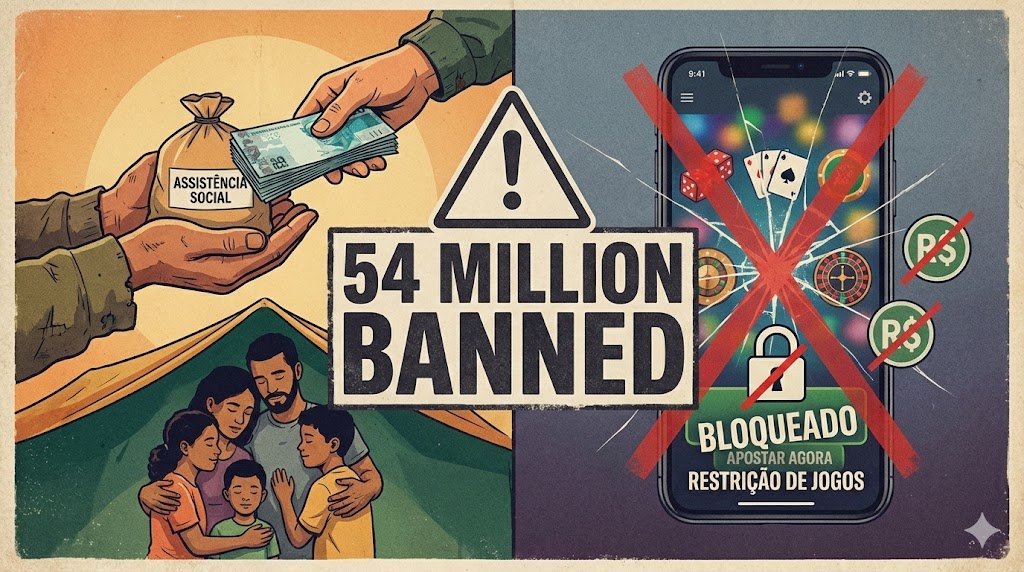
The political backlash was immediate and intense. In September 2025, the SPA implemented a complete ban on betting by Bolsa Família and BPC (social assistance) recipients - affecting more than 54 million people. Licensed operators must now query government databases to identify and block prohibited bettors.
Industry groups predict the ban will backfire. An ANJL study found 45% of banned welfare recipients plan to continue gambling through black market operators. The restriction may simply redirect vulnerable populations toward platforms with no consumer protections whatsoever.
Influencer marketing triggered criminal investigations
Brazil's gambling market became entangled with influencer culture in ways regulators didn't anticipate. A Congressional Parliamentary Inquiry examined betting's societal impact, with high-profile influencers like Virgínia Fonseca (53 million followers) facing potential indictment for promoting gambling platforms under contracts reportedly worth R$29 million.
Research painted a troubling picture: 30% of gambling ads promised easy winnings, 60% appeared after such claims were banned, and 55% of favela residents were influenced by celebrity endorsements. The "Fortune Tiger" scandal - involving an Asian-themed slot game marketed through deceptive influencer schemes using demo accounts to display fake winnings - prompted police operations across multiple states.
The Senate approved restrictions in May 2025 proposing bans on betting ads during live sports broadcasts and prohibition of celebrity endorsements. Only athletes retired for five or more years would be permitted. Industry projections suggest these restrictions could cause 15-20% revenue decline if fully enacted.
Several major operators chose to exit or were excluded
Not everyone made it into the regulated market. Cryptocurrency-focused platforms faced a fundamental problem: Brazil banned crypto payments for gambling entirely. Sportsbet.io, 188bet, and Betway announced exits before January 2025.
The most controversial exclusion involved Esportes da Sorte, Brazil's third-largest operator by market share. Owner Darwin Henrique da Silva Filho was arrested in September 2024 as part of "Operation Integration," a money laundering investigation. Initially excluded from the federal approved list, the company obtained a state license from Rio de Janeiro's LOTERJ and later secured a federal court injunction allowing nationwide operation.
Similar investigations ensnared VaideBet (8th largest operator) and Zeroumbet (linked to influencer Deolane Bezerra). At least eight federal lawsuits were filed by excluded operators challenging SPA decisions - highlighting ongoing tensions between regulatory authority and market access.
Federal-state conflicts created regulatory arbitrage
A structural problem emerged when state lotteries began licensing operators at significantly lower fees. Rio de Janeiro's LOTERJ charged R$5 million versus the federal R$30 million - an 83% discount. On January 2, 2025, the Supreme Federal Court stepped in, barring LOTERJ-licensed operators from operating beyond state borders and requiring geolocation blocking for out-of-state players.
The .bet.br domain requirement faces its own legal challenge from ANALOME (the state/municipal lottery association), arguing federal rules violate free enterprise principles. Multiple states including Rio de Janeiro, Paraíba, Paraná, and Maranhão maintain separate licensing regimes.
For operators, this creates complexity. For players in states with local licensing, it creates confusion about which platforms are actually legal for their location.
Player protection requirements set global benchmarks
Brazil implemented what may be the world's strictest player protection regime. Most notably: facial recognition is mandatory for all players. Brazil is the only country requiring universal biometric verification for gambling. Additional KYC requirements include CPF (taxpayer ID) verification, proof-of-life checks, geolocation confirmation, and multi-factor authentication.
Responsible gambling measures include mandatory deposit limits, loss limits, time limits, betting frequency controls, and automatic alerts for concerning patterns. A centralized self-exclusion platform launched in late 2025, allowing players to block themselves from all 182+ licensed platforms simultaneously.
Welcome bonuses are banned. Credit cards, cryptocurrency, cash, and boletos (payment slips) are prohibited - only PIX, debit cards, and bank transfers allowed. Analyst Ed Birkin described early compliance as a "bloodbath" due to difficult onboarding, estimating a 20% initial GGR drop versus pre-regulation levels.
These protections matter for players considering legitimate regulated options versus offshore alternatives with no accountability.
The numbers exceeded expectations despite everything
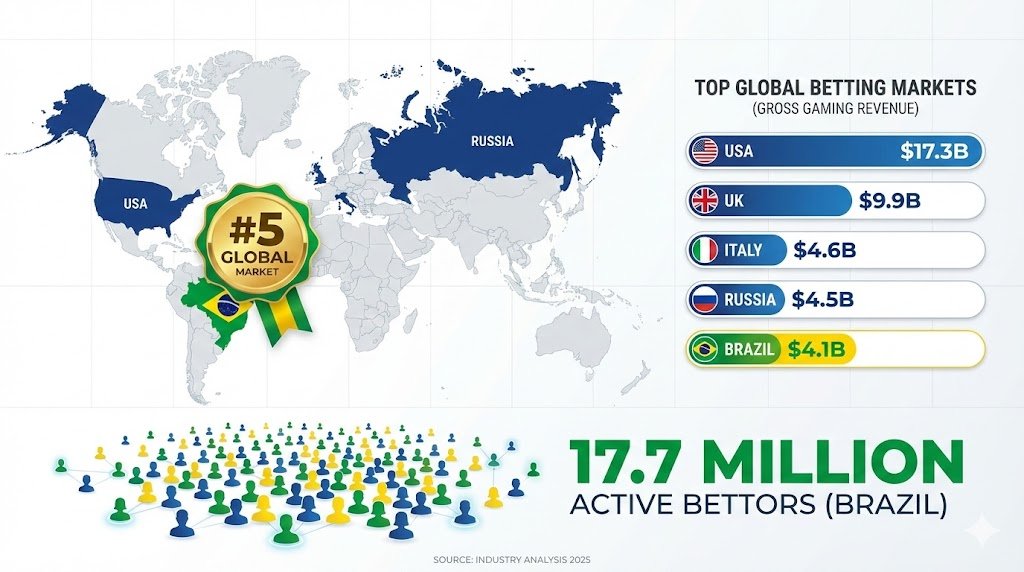
Through all the controversies, the market performed. R$17.4 billion in GGR during the first six months. Monthly revenue grew from R$2.03 billion in January to R$3.52 billion in May. The 17.7 million active bettors spent an average of R$983 each over six months.
Demographics reveal the market's composition: 71% male, with the 31-40 age bracket (27.8%) leading participation. Football dominates sports betting at 86% of GGR. But the real surprise? iGaming - slots and casino games - accounts for 55-60% of total revenue, outpacing sports betting despite Brazil's football obsession.
Regulus Partners projects $4.139 billion in 2025 GGR, placing Brazil fifth globally behind the USA ($17.3B), UK ($9.9B), Italy ($4.6B), and Russia ($4.5B). H2 Gambling Capital estimates the market may attract 39 million active accounts by 2026.
What happens next
Brazil proved a massive gray market can be brought into regulation relatively quickly. The first year generated billions in tax revenue, created a framework for player protection, and established enforcement mechanisms that - while imperfect - demonstrate governmental commitment.
But the experiment also revealed tensions that other markets should note. Aggressive taxation risks driving players to unregulated alternatives. Restricting vulnerable populations may simply push them toward less safe options. And enforcement against thousands of illegal domains resembles an expensive game of whack-a-mole.
The December 2025 announcement of further tax increases - GGR rising to 18% plus a new 15% tax on player deposits - drew immediate industry criticism. IBJR warned the changes would "strengthen organized crime" by improving black market competitiveness. Whether Brazil finds the right balance between revenue extraction and market health will determine if its gambling experiment succeeds long-term.