Why Philippines Online Gambling Surged 82% in One Year

The Philippines online gambling sector posted an 82.67% year-over-year surge in H1 2025. That's not a typo. PAGCOR's latest figures confirm e-games generated PHP 114.83 billion ($1.99 billion) in the first half of 2025, commanding 53.47% of total gross gaming revenue - the first time online gambling has overtaken land-based operations in the country's history.
Total GGR hit PHP 214.75 billion ($3.72 billion), up 26% from the same period last year. Meanwhile, land-based casinos fell 5.85% to PHP 93.36 billion. Something fundamental shifted in how Filipinos gamble, and the causes reveal a playbook that other emerging markets are already studying.
PAGCOR's Regulatory Pivot
The Philippine Amusement and Gaming Corporation didn't stumble into this growth. They engineered it.
License fees dropped from 50% of GGR before August 2022 to just 25-30% by January 2025 - aligning with global standards and converting grey-market operators to licensed status. PAGCOR Chairman Alejandro Tengco was explicit about the strategy: lower fees attract investment, investment creates jobs, jobs generate tax revenue. The math worked.
The July 2024 POGO ban proved equally consequential. President Marcos ordered all Philippine Offshore Gaming Operators shut down by December 31, 2024, eliminating an industry plagued by kidnappings, human trafficking, and money laundering scandals. Executive Order No. 74 redirected regulatory attention entirely to domestic e-games. PAGCOR's licensed domestic platforms jumped from capturing roughly 40% of online gambling to becoming the sole legal option.
A March 2024 moratorium on new licenses froze the market at approximately 77 licensed operators. This protected incumbents from fragmentation while creating barriers that filtered out fly-by-night operations. Server localization requirements - all gaming infrastructure must physically reside in the Philippines - embedded compliant platforms deeper into the domestic ecosystem.
Mobile and E-Wallet Infrastructure
The Philippines represents perhaps the most mobile-ready gambling market in Asia. 142 million cellular connections serve a population of 116 million - a 122% penetration rate. Internet access reaches 83.8% of citizens, with 97.5 million active users spending an average of 8.5 hours daily online. That's the highest in the Asia-Pacific region.
But the real story is payments.
GCash dominates digital payments with 94 million users and 89% market share. The e-wallet eliminated traditional banking barriers for gambling - deposits as low as ₱20 can be made instantly via phone number or QR code. Platforms offering fast payouts typically clear withdrawals within 24 hours. Maya (formerly PayMaya) adds another 44 million users. E-wallet penetration among Filipinos aged 18-45 reached 92% by early 2025.
This payments infrastructure explains a counterintuitive finding: only 7% of online gamblers migrated from land-based casinos. According to The Fourth Wall's 2025 survey of over 1,000 players, most users came from unregulated street-based games - sabong (cockfighting), perya (local gambling), and Facebook betting groups. E-wallets created a bridge from informal gambling to licensed platforms.

COVID's Permanent Behavioral Shift
The pandemic rewired Filipino gambling behavior permanently. When PAGCOR authorized Philippine Inland Gaming Operators (PIGOs) to offer remote gaming in December 2020, it was intended as a temporary revenue measure during lockdowns. Instead, it triggered a structural shift that industry panelists at G2E Asia Philippines 2025 estimated accelerated online adoption by "at least a decade."
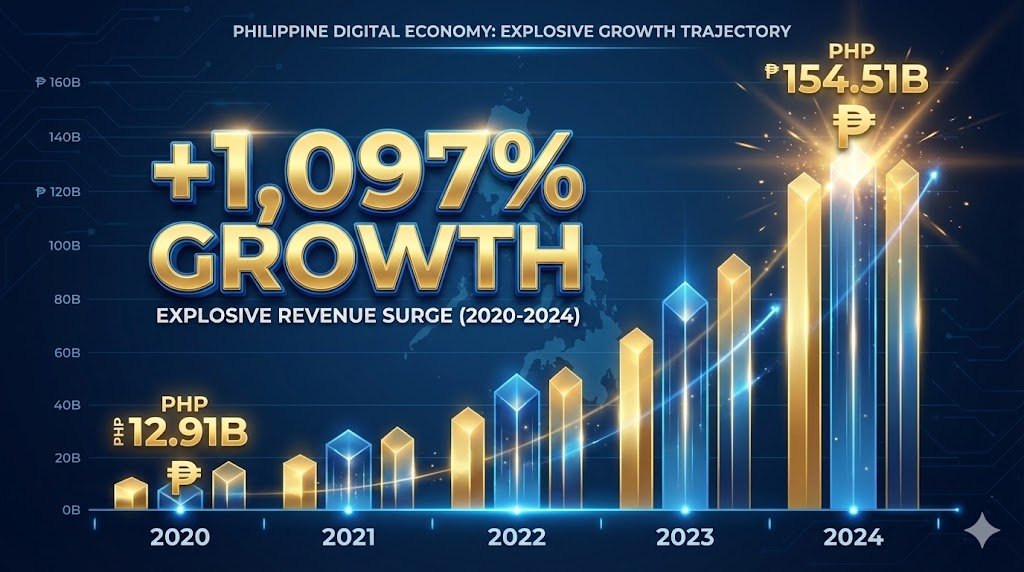
E-games GGR exploded from PHP 12.91 billion in 2020 to PHP 154.51 billion in 2024 - a 1,097% increase over four years. Daily gambling frequency increased from 29% of users in 2022 to 39% in 2023, with average weekly sessions climbing from three to four. These patterns persisted well after COVID restrictions ended, suggesting permanent habit formation rather than temporary substitution.
By early 2025, 32 million Filipinos had engaged in online gambling in the first five months alone - a 291% surge from 8.2 million during the same period in 2024.
DigiPlus Shows How Scale Compounds
The market's concentration reveals how regulatory frameworks can create dominant players. DigiPlus Interactive Corp. operates BingoPlus, ArenaPlus, and GameZone, accumulating over 40 million registered users by 2024 - double the previous year. BingoPlus revenues surged 306% to PHP 27.3 billion in 2023.
The company operates 140+ physical sites nationwide while offering 1,000+ e-casino games from providers like Evolution - which powers live dealer experiences across the platform - and Jili. DigiPlus's scale creates compounding advantages: marketing budgets that competitors cannot match, preferential e-wallet integrations, and the regulatory relationships that come with being responsible for significant tax contributions.
BingoPlus became the only non-casino operator approved for online casino games under the PIGO framework, effectively locking in its market position. Meanwhile, legacy operators struggled. PhilWeb Corp., a pioneer e-games provider, posted a PHP 599 million net loss in 2024, overwhelmed by DigiPlus's user acquisition spending.
Celebrity Marketing Blitz
Before PAGCOR's August 2024 advertising crackdown, gambling platforms dominated Philippine public spaces. Industry observers noted gambling ads occupied roughly one in three LED faces along EDSA in Manila - the fastest-growing advertising category after telecommunications.
The promotional ecosystem included 15+ top Filipino celebrities: Alden Richards, Julia Barretto, Maine Mendoza, Vice Ganda, and Kim Chiu among others endorsing platforms like BingoPlus, ArenaPlus, and OKBet. Welcome bonuses of 100-200% deposit matches, free spins, and cashback deals lowered trial barriers. Push notifications, pop-under ads, and Telegram Mini Apps maintained engagement.
PAGCOR imposed restrictions effective August 2024 - banning outdoor ads, prohibiting primetime TV spots between 5:30-8:30pm, and requiring removal of billboards near schools and churches. But the customer acquisition had already occurred, with awareness levels reaching 92% nationwide.
Land-Based Struggles Despite Expansion
While online gambling surged, land-based casinos contracted 5.85% to PHP 93.36 billion in H1 2025. Even Entertainment City's integrated resorts - Solaire, Resorts World Manila, City of Dreams, Okada Manila - saw their share of total GGR decline as e-games captured the marginal peso.
Hann Casino Resort's December 12, 2025 "Canyon" expansion illustrates how land-based operators are responding. The first floor added 584 slot machines and 34 gaming tables, featuring Aristocrat Gaming's new titles including Tian Ci Jin Long (a Philippine debut). The PHP 6 billion financed expansion increases Hann's slot inventory by approximately 50%, betting that premium experiences can compete with digital convenience. A second floor targeting VIP gaming is scheduled for Q1 2026.
It's a familiar pattern: land-based operators chasing the high-roller segment while mass-market players move online. Whether that strategy works depends on how regulators handle what comes next.
The Backlash Is Already Here
The sector's expansion has triggered political backlash that may reshape its future. Senator Raffy Tulfo labeled online gambling an "epidemic" following Senate hearings featuring mothers whose sons committed suicide over gambling debts. Senator Joel Villanueva filed the "Anti-Online Gambling Act" seeking complete prohibition. The Catholic Bishops' Conference described online gambling as a "new plague."

The August 2025 Bangko Sentral ng Pilipinas directive ordering e-wallets to delink from gambling sites produced immediate impact: online gambling transactions dropped approximately 50%, and PAGCOR monthly income fell from PHP 5.7 billion in May to PHP 2.9 billion in September.
Chairman Tengco warned the restriction was driving players to the estimated 12,000 illegal gambling sites operating daily - versus just 77 licensed platforms. PAGCOR's position favors stricter regulation over prohibition, arguing that banning legal operators would eliminate over 50,000 jobs while handing the market to unregulated offshore platforms based in Russia, Dubai, and Cambodia.
President Marcos has ordered a "thorough study" of economic impacts before committing to policy direction. The regulatory environment entering 2026 is genuinely uncertain - and that uncertainty is the point. The same growth metrics driving regulatory revenue have triggered social concerns that could fundamentally restrict the sector.
For operators watching the Philippine market, there's a lesson here about velocity. Growing 82% in a year attracts attention. Not all of it helpful.