Finland's 158-8 Vote Just Killed Europe's Last Major Gambling Monopoly
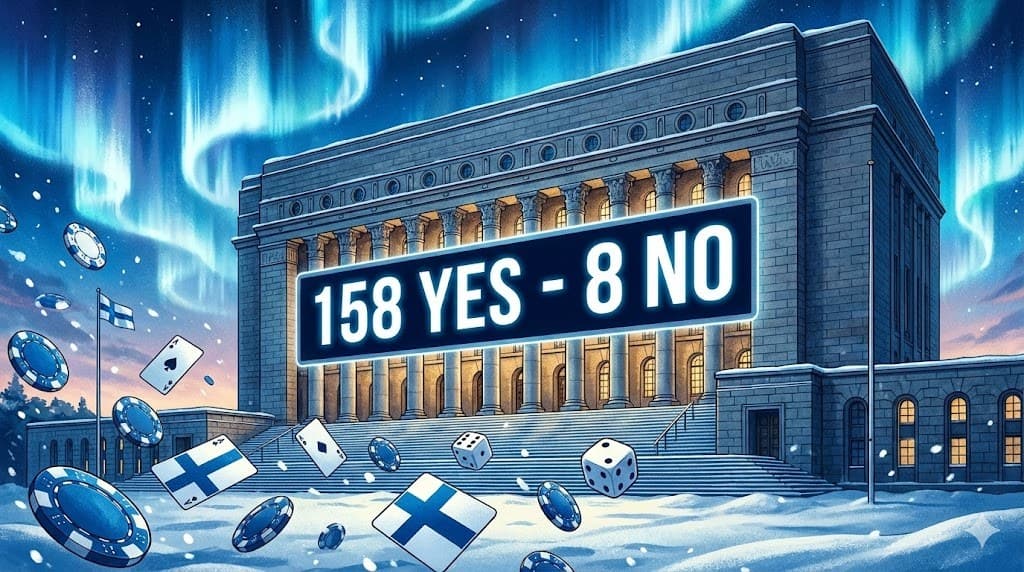
Finland's parliament didn't just approve gambling reform on December 16. It buried the Veikkaus monopoly with a margin that surprised even supporters - 158 votes in favor, just 8 against. The landslide signals something bigger than one Nordic country opening its market. It marks the end of an era where European governments could pretend state-run gambling operators were actually controlling their markets.
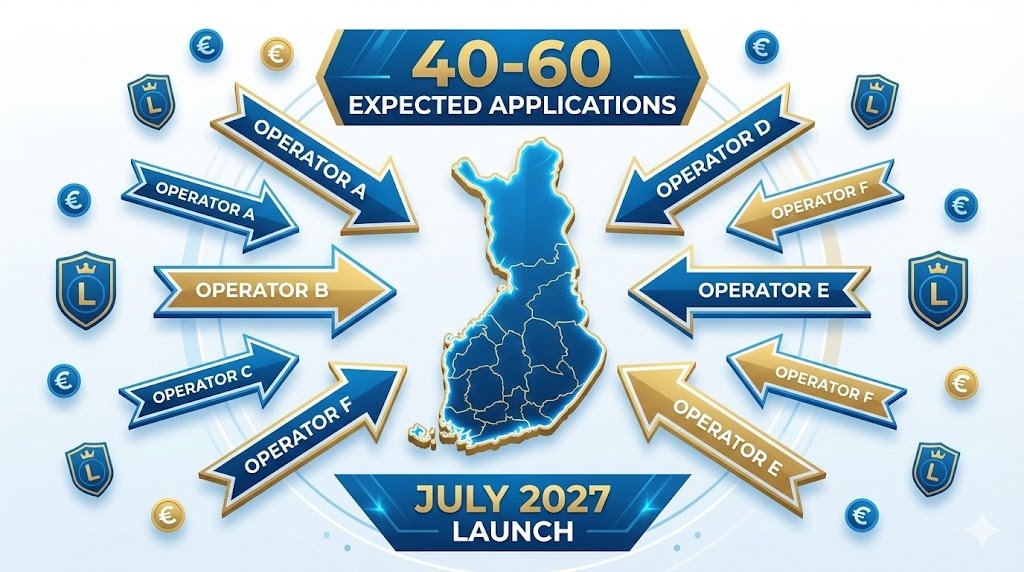
The new multi-license system launches July 1, 2027. That's six months later than originally planned, but the delay matters less than what happens next: dozens of international operators preparing to enter a €2.4 billion market that's been technically illegal to compete in for decades.
Why the vote wasn't even close
The 158-8 margin tells the real story. Even opposition parties that pushed for stricter regulations voted yes on the final bill. Why? Because the alternative - maintaining a monopoly that captured less than half the market - had become indefensible.
Veikkaus held exclusive legal rights to online gambling. Yet in 2025, the company controlled just 48% of Finnish players' spending. The rest - somewhere between €600 million and €900 million annually - flowed to offshore operators paying zero taxes and offering zero player protections. Deputy CEO Velipekka Nummikoski put it bluntly: Veikkaus hasn't had a real monopoly for years.
National Coalition MP Juha Hänninen captured the parliamentary mood: "The current gambling system no longer reflects reality. A significant part of gambling takes place outside our current system, online and on the platforms of foreign operators."
Parliament rejected the restrictive amendments
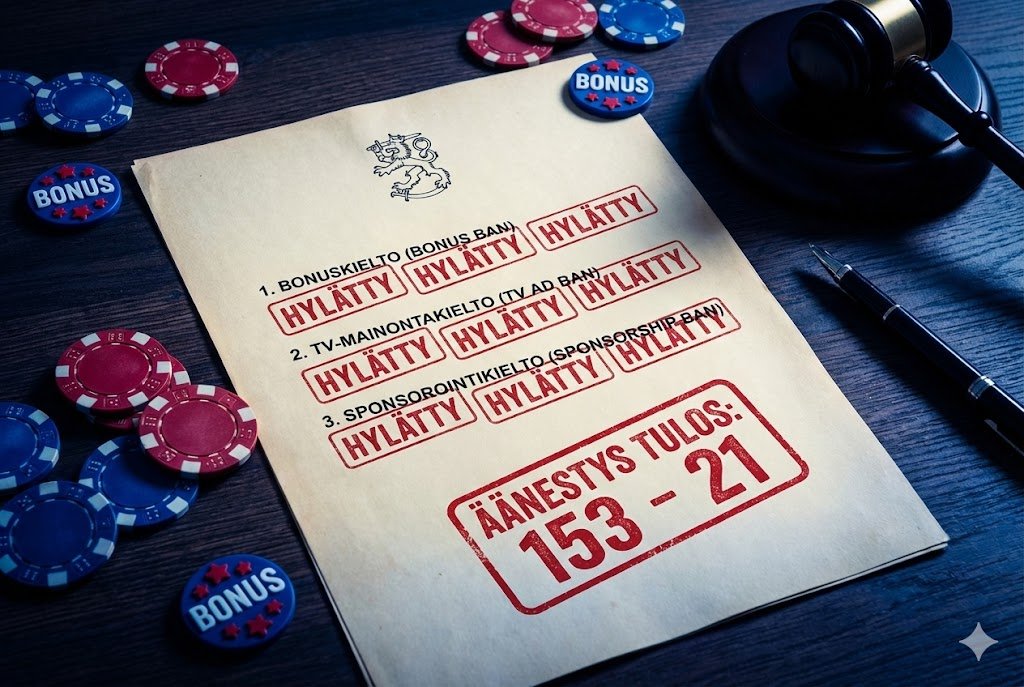
The December 16 final vote followed a December 11 session where MPs killed a package of opposition amendments by 153-21. The Green Party and Left Alliance had proposed turning Finland's new market into one of Europe's most restricted. They failed on every count.
The bonus ban proposal would have prohibited welcome offers, deposit matches, free spins, and loyalty programs entirely. Government supporters called it "self-harming against the offering of illegal operators." The approved framework instead allows retention bonuses of moderate value with wagering requirements capped at 5x - but bans all acquisition bonuses designed to attract new players.
A complete TV and radio advertising ban also went down. Left Alliance MP Aino-Kaisa Pekonen argued that gambling ads normalize the activity and trigger relapses among problem gamblers. The counterargument won: broadcast advertising will be permitted under "moderate marketing" standards, though influencer marketing and affiliate programs are expressly banned.
Sports sponsorship restrictions faced similar defeat. Operators can sponsor teams and events, just not promote specific gambling products through those deals.
Other rejected amendments included raising the gambling age to 20, increasing GGR tax from 22% to 25.5%, mandatory two-factor authentication for every login, and tobacco-style health warnings on all advertising. A proposal to ban marketing to anyone under 24 also failed.
The licensing framework: 22% tax, unlimited licenses
Finland is betting on competition rather than artificial scarcity. The new system features a 22% GGR tax - competitive with Denmark's rates and significantly lower than Sweden's effective burden when you factor in bonus restrictions. Application fees run €29,000, with annual supervision fees scaling from €4,000 to €434,000 based on operator revenue.
Crucially, there's no cap on license numbers. Any operator meeting regulatory requirements can apply. This open approach mirrors Denmark's successful model rather than limiting the market to a handful of incumbents.
The regulatory architecture shifts oversight from the National Police Board to a new Finnish Licensing and Supervision Authority under the Ministry of Finance. License applications open March 1, 2026, giving operators 16 months to prepare before the market goes live.
Why the six-month delay from January to July 2027? Parliamentary representative Sinuhe Wallinheimo explained the primary bottleneck: "The Licensing and Supervision Authority needs dozens of people to carry out this supervision. Such an organisation does not exist before 2027." Constitutional Law Committee concerns about vague "moderate marketing" definitions added further complications.
Player protections embedded in the legislation include centralized self-exclusion registers across all operators, mandatory deposit and loss limits set before first deposits, and ongoing monitoring for harmful play patterns. Game design restrictions - maximum stakes, minimum game duration, autoplay limitations - will be defined by ministerial decree.
Veikkaus positioned itself as reform architect, not victim
Here's the twist: Veikkaus didn't fight this. The company initiated reform discussions back in 2022 and has positioned the vote as a strategic opportunity rather than an existential threat.
The bifurcated market lets Veikkaus keep exclusive rights over lotteries, Eurojackpot, scratch cards, and land-based gaming including Casino Helsinki. For online betting, casino, and slots - the growth segments - Veikkaus will need to apply for licenses like everyone else.
Deputy CEO Nummikoski called the vote "a historic change and a major opportunity." The company has already begun restructuring: October 2025 announcements included approximately 31 job losses offset by 22-28 new specialized roles. Earlier preparations affected up to 240 positions.
The strategic logic makes sense. With online market share eroding to 36% and 2.625 million registered players increasingly choosing offshore alternatives, defending an unenforceable monopoly offered diminishing returns. Competing on a level playing field - with access to bonuses and marketing tools currently available only to offshore competitors - might actually improve Veikkaus's position.
Major operators are already circling
Industry reaction has been enthusiastically positive. EGBA Secretary General Maarten Haijer declared the reform "a major milestone representing a fundamental change in Europe's regulatory landscape" and validation that "competitive, well-regulated markets are the best way to protect consumers."
Entain has explicitly confirmed interest. Chief Operating Officer Dainis Niedra stated: "Finland is a very interesting market for Entain, and we will definitely apply for a license." Kindred Group (Unibet, 32Red) has a "clear pipeline for Finland's 2027 licensing regime," with General Manager Joel Hakamies calling it "definitely a major opportunity." Betsson, despite receiving a €2.4 million fine for previously targeting Finnish customers, has signaled strong interest to investors.
Finnish platform provider Finnplay has already secured multiple letters of intent from prospective operators. Industry estimates project 40-60 license applications when the window opens.
But concerns persist about enforcement capabilities. Hippos ATG's Chief Compliance Officer Antti Koivula warned of "nothing but enforcement challenges" ahead, noting the legislation lacks payment blocking or DNS blocking provisions. University of Helsinki researcher Janne Nikkinen predicts Finland will need to revise the law again by 2029 or 2030.
Denmark's success vs. Sweden's struggles - which path will Finland follow?
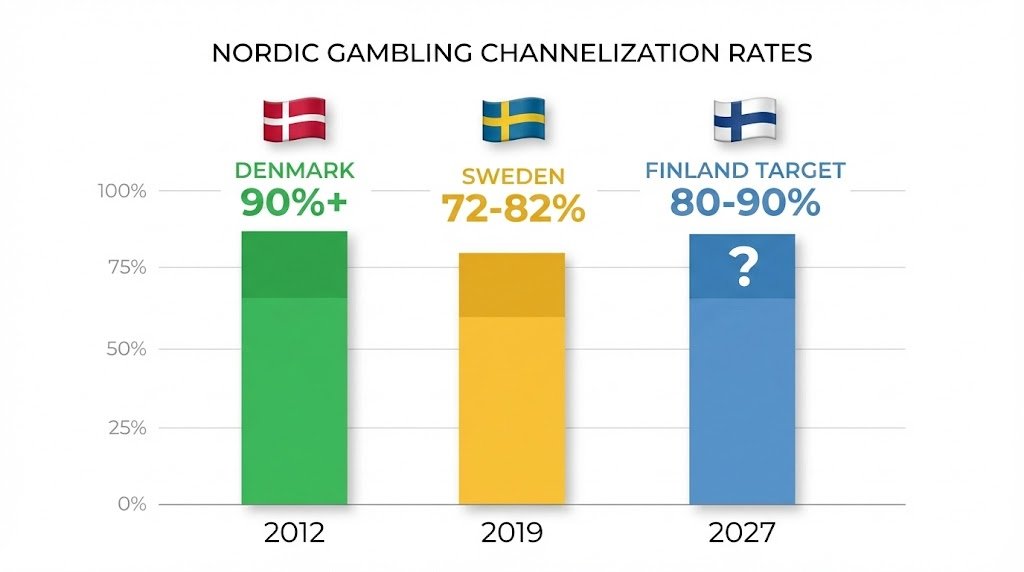
Finland's framework explicitly draws lessons from Nordic neighbors. Denmark liberalized in 2012 and achieved 90%+ channelization - the highest rate in Europe - through balanced regulation that maintained operator attractiveness while enforcing consumer protections. That's the target.
Sweden's 2019 liberalization offers the cautionary tale. Despite similar intentions, Swedish online casino channelization sits at 72-82%, with traffic to unlicensed sites increasing tenfold since reform. The Swedish bonus ban - limiting welcome offers to a one-time SEK 100 (approximately €9) - drove players offshore in droves. Finland's decision to permit retention bonuses and reject the complete bonus ban reflects this learning.
The Netherlands gambling tax increase showed what happens when regulation becomes too burdensome - legal market contraction and player migration to unlicensed alternatives. Finland appears determined to avoid that outcome.
With 65% of Finnish gambling activity occurring online and 44% of adults engaging in online gambling, successful channelization could generate annual tax revenue exceeding €850 million by 2030. The government's target: 80-90% of players choosing licensed operators.
Norway now stands alone
Finland's vote leaves Norway as the EU's sole remaining gambling monopoly. Norsk Tipping's exclusive rights face the same fundamental problem Veikkaus couldn't solve - unlicensed operators capturing growing market share while paying nothing back.
Industry groups and EGBA are already calling for Norwegian liberalization. Finland's success or failure over the coming years will significantly influence that regulatory debate in Oslo.
For players currently using offshore sites in Finland, the calculus shifts in 2027. Licensed operators will offer the bonuses and game variety they want, plus actual regulatory protection if something goes wrong. The question is whether 18 months is enough time to build an enforcement apparatus that makes choosing unlicensed operators genuinely inconvenient.
March 2026 brings the first license applications. July 2027 brings the market launch. And somewhere in between, we'll find out whether Finland learned the right lessons from its neighbors - or just became another cautionary tale for whoever comes next.