Maine Just Gave 4 Tribes Exclusive Rights to Run Its Entire Online Casino Market
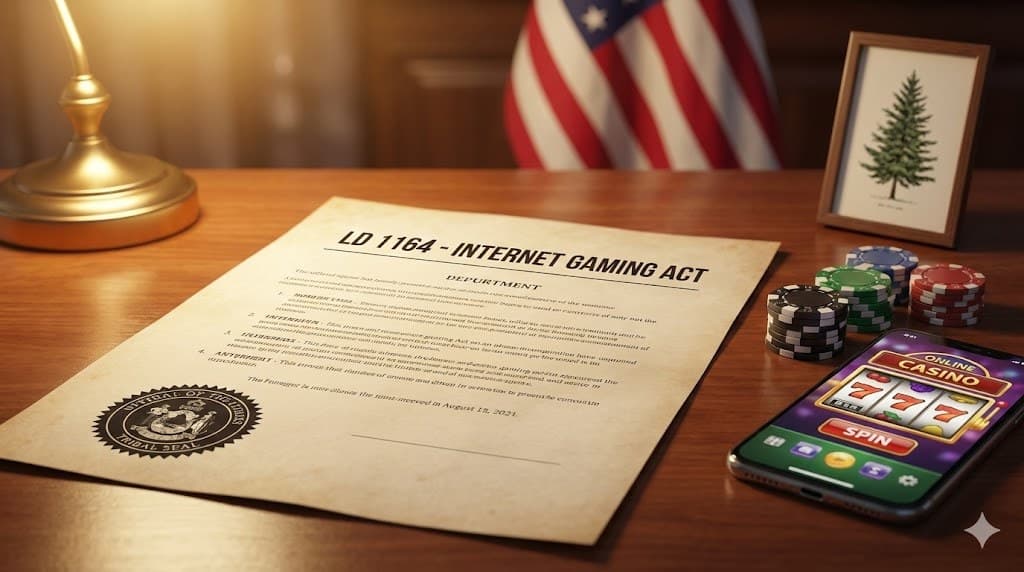
Maine became America's eighth legal online casino state on January 10, 2026 - and it did so in a way no other state has tried. Governor Janet Mills let LD 1164 become law without her signature, handing the four Wabanaki Nations exclusive rights to operate every online slot, table game, and poker room in the state. No commercial casinos allowed. No open-market licensing. Just four tribal operators, four platform partners, and an 18% tax rate that Wall Street analysts are already calling a bargain.
Churchill Downs, which owns Maine's Oxford Casino, filed a federal lawsuit within two weeks calling the whole thing an unconstitutional "race-based monopoly." The legal fight that follows could reshape tribal gaming rights across America.
What LD 1164 Actually Covers
The law grants online gaming rights to Maine's four federally recognized Wabanaki tribes: the Passamaquoddy, the Penobscot Nation, the Houlton Band of Maliseet Indians, and the Mi'kmaq Nation. Each tribe gets one iGaming license and can partner with one commercial platform operator - meaning Maine's entire online casino market will consist of exactly four skins.
Compare that to New Jersey's 28 or Pennsylvania's 21 active platforms. Maine is doing this differently on purpose.
The game library is broad: slots, blackjack, poker, craps, roulette, baccarat, and anything else the Gambling Control Unit director approves. This also makes Maine the ninth US state with regulated online poker - a detail that's flown under the radar. Licensing fees are modest at $50,000 annually per tribal license and $10,000 for management partners, a fraction of the multi-million-dollar fees proposed in states like New York and Virginia.
Follow the Money: 18% Tax and $236 Million Projections
The 18% tax on adjusted gross gaming revenue flows into eight specific state funds - from veterans' homes to dairy stabilization to opioid treatment. Maine's own fiscal note is conservative: $1.8 million in Year 1, scaling to $3.6 million. But Wall Street sees a much bigger picture.
Truist Securities projects $55 million in operator revenue in Year 1, growing to $120 million by 2030. J.P. Morgan estimates around $200 million annually at maturity. Deutsche Bank's most bullish model hits $236 million - with a high-end scenario of $482 million. For a state of 1.4 million people, those numbers are significant.
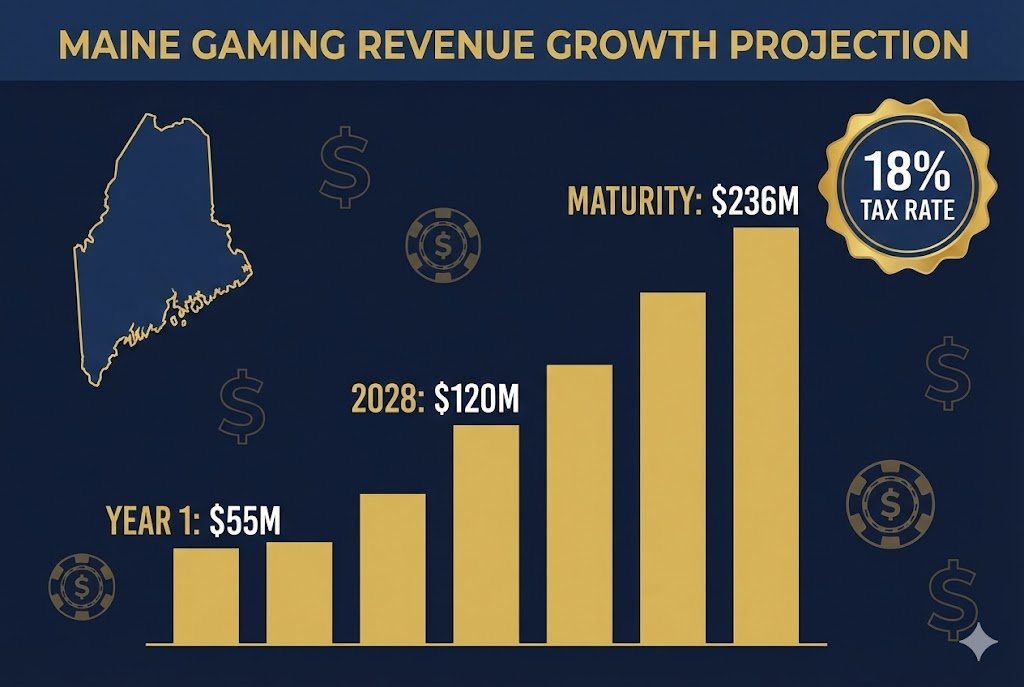
The 18% rate itself is competitive. It matches Connecticut's tribal rate and beats West Virginia's 15%, but sits far below Pennsylvania's brutal 54% on online slots. J.P. Morgan analyst Daniel Politzer noted this is "remarkably" low at a time when gambling taxation keeps trending upward across the industry - Illinois recently hit 40% on sports betting, Ohio doubled to 20%, and New Jersey raised to 19.75%.
Why the Wabanaki - and Why This Took 40 Years
This isn't just another iGaming bill. It's the result of a legal quirk that's haunted Maine's tribes for four decades.
The Maine Indian Claims Settlement Act of 1980 resolved Wabanaki land claims to nearly two-thirds of the state but created a bizarre side effect: it treats Maine's tribes more like municipalities than sovereign nations. That distinction means the Indian Gaming Regulatory Act of 1988 - the federal law that enabled 243 tribal nations across 29 states to build 532 gaming operations generating $43.9 billion in fiscal year 2024 - doesn't apply to the Wabanaki.
For over 30 years, roughly 8,700 Wabanaki citizens in Maine's most economically disadvantaged counties watched other tribes build casino empires while their only gaming revenue came from a 4% share of Oxford Casino's slot machine proceeds. About $3.6 million per year, split among all four nations.
Sports betting changed the trajectory. When Maine launched tribal-exclusive mobile wagering in November 2023, DraftKings partnered with the Passamaquoddy and captured 80% market share, generating an estimated $25-26 million annually for one tribe - nearly double the Sipayik reservation's entire government budget. That success made the case for iGaming almost impossible to argue against.
Churchill Downs: "If You're Going to Allow It, Let Us Compete"
On January 23, 2026 - less than two weeks after the law took effect - Churchill Downs filed suit in US District Court for the District of Maine. The complaint targets the Gambling Control Unit's executive director and alleges violations of the Equal Protection Clause, the Dormant Commerce Clause, and Maine's ban on "special legislation."
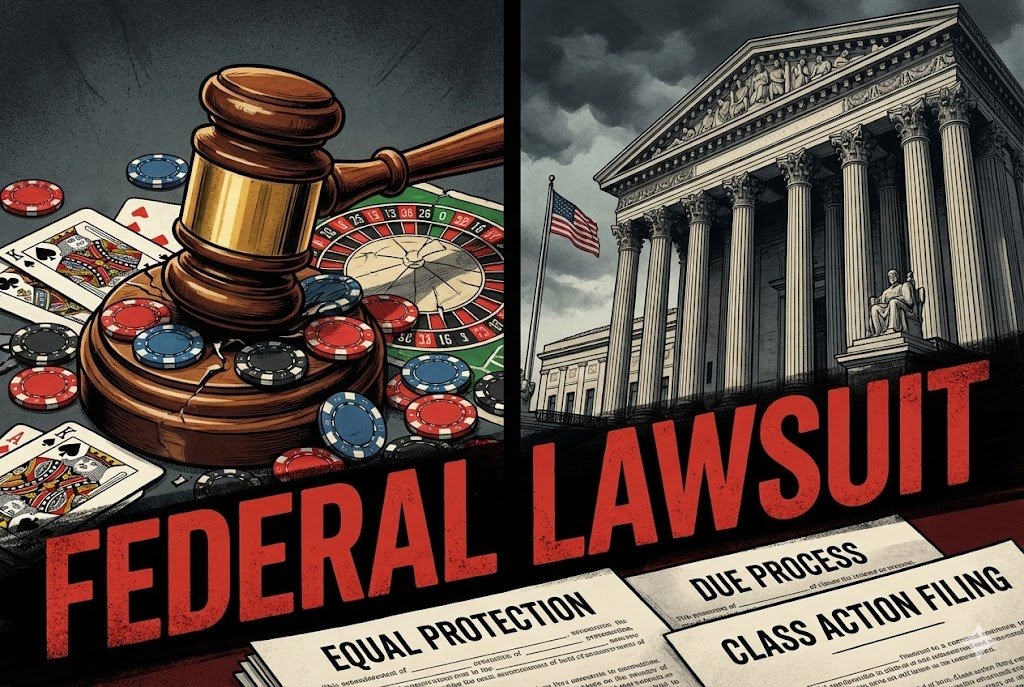
The core argument: tribal membership is a racial classification, making LD 1164's exclusivity an unconstitutional race-based preference. CDI cites a study projecting that iGaming would cause a 16% decline in land-based casino revenue, costing 378 jobs and $60 million in economic output.
But here's where it gets awkward. The complaint explicitly states that CDI believes "no entities should be allowed to offer iGaming in the State of Maine" - then adds that since Maine decided to allow it, CDI "would apply for an iGaming license." Gaming attorney Dennis Ehling of Blank Rome flagged the contradiction: the remedy Churchill Downs seeks would require expanding something they claim to oppose.
The bigger problem for CDI? This argument already lost. In Maverick Gaming v. United States, a Washington state card room operator challenged tribal-exclusive sports betting on nearly identical equal protection grounds. The case was dismissed at the district level, affirmed by the Ninth Circuit, and the US Supreme Court declined to hear it in October 2025. Twenty-two tribal nations and the DOJ itself argued against Maverick's position. Multiple legal experts see CDI's challenge facing the same outcome.
The Passamaquoddy's Representative Aaron Dana called the lawsuit "very hypocritical," pointing out that Oxford Casino already holds exclusive brick-and-mortar rights - a monopoly CDI apparently finds acceptable when it benefits them.
The Operator Race: Four Skins, Major Stakes
DraftKings is almost certainly locked in with the Passamaquoddy, extending a sports betting partnership that already dominates the state. Truist projects DraftKings could generate $20-30 million in incremental EBITDA from Maine iGaming. DraftKings was also the only major operator to testify in favor of LD 1164 - a calculated bet that's about to pay off.
Caesars holds the current sports betting partnerships with the Penobscot, Maliseet, and Mi'kmaq. But the iGaming law's one-operator-per-tribe structure creates room for diversification. Not all three tribes need to stick with Caesars, and at least one or two partnerships are likely up for grabs.
Rush Street Interactive emerged as a dark horse at the ICR Conference in January 2026. RSI's president stated Maine "would fit really, really well" for the company, citing its experience running Delaware's sole iGaming platform - relevant proof that RSI can thrive in limited-operator markets.
FanDuel, BetMGM, and Fanatics all testified against the bill during hearings. Their objection was to the exclusivity, though - not to operating in Maine. Any tribe looking to maximize revenue would find FanDuel's position as the nation's second-largest iCasino operator hard to ignore.
Maine Enters a $10 Billion US Market
Maine's timing coincides with explosive growth in US iGaming regulation. The seven existing legal states generated $8.41 billion in gross gaming revenue in 2024 - up 28.7% year-over-year - and 2025 is on pace to crack $10 billion for the first time. Michigan, New Jersey, and Pennsylvania together account for over 83% of that revenue, with iGaming actually surpassing brick-and-mortar casino revenue in both Michigan and Pennsylvania during 2025.
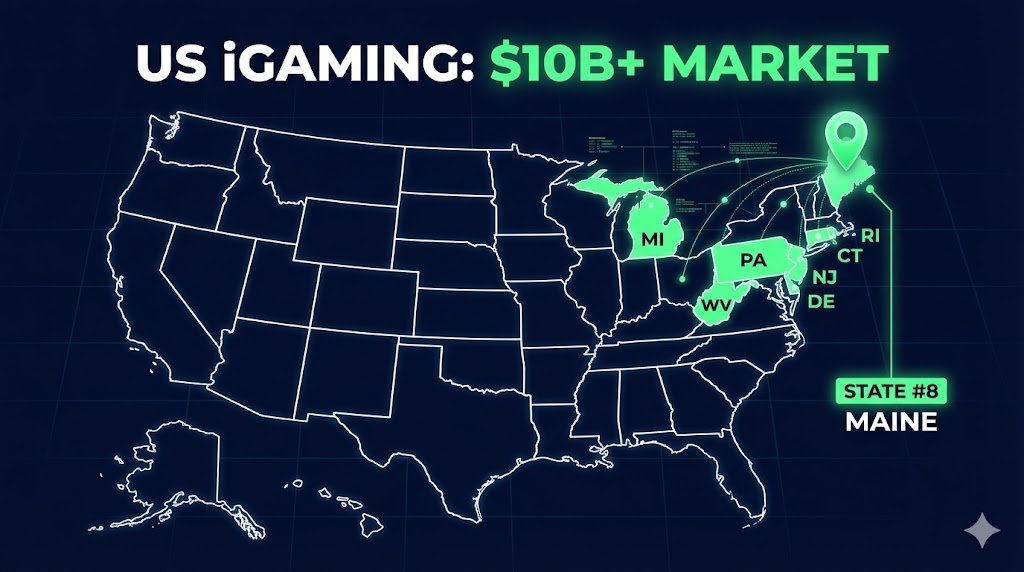
The legislative pipeline suggests Maine is riding the front of a larger wave. Virginia's HB 161 cleared committee in early February 2026 with a proposed 15% tax rate. New York's SB 2614 proposes a 30.5% rate that could generate $1 billion annually. Illinois refiled its own iGaming bill on February 2, 2026 at a 25% rate. Massachusetts, Ohio, Indiana, and Maryland all have active legislation in various stages.
The contrast with the US sweepstakes casino crackdown is striking: as states shut down the gray market, they're simultaneously opening regulated channels. Maine chose the narrowest possible version - four tribal operators in a fully regulated framework. Whether that model attracts players away from unregulated offshore sites remains the open question.
When Can Players Actually Log In?
Not anytime soon. The law takes effect 90 days after the legislature adjourns, expected around mid-July 2026. The Gambling Control Unit then needs to draft rules, vet license applications, and test platforms. The GCU director was notably slow launching sports betting by national standards, and most realistic projections point to late 2026 or early 2027 for actual go-live.
Two threats could push that timeline even further. A preliminary injunction from the Churchill Downs lawsuit would freeze implementation entirely. And the National Association Against iGaming - a lobbying group CDI helped found - is running a People's Veto petition campaign. If they collect enough signatures, LD 1164 gets suspended pending a public vote at the November 2026 election. A NAAiG-commissioned poll claims 64% of Maine voters oppose online gambling, though polls funded by opposition groups deserve the appropriate skepticism.
For players exploring regulated options while waiting for Maine and other states to come online, licensed and top rated online casinos operating under established jurisdictions remain the safest choice.
A Model With No Precedent - and No Guarantee
Maine just built something that doesn't exist anywhere else in American gaming: tribes with exclusive online casino rights, no physical casinos, no IGRA compact, and a regulatory framework entirely under state law. If it works, it's a template for other states weighing tribal-led iGaming expansion. If Churchill Downs wins in court - or voters kill it in November - the whole experiment ends before a single slot spins.
Either way, the Wabanaki Nations are closer to meaningful participation in a $44 billion tribal gaming industry than they've been since the 1980 Settlement Act locked them out. Whether "closer" becomes "in" depends on what happens in a federal courtroom over the next six months.