For over two decades, a single statistic has haunted lottery winners: “70% go bankrupt within a few years.” This number appears in financial columns, viral tweets, and cautionary news segments. It has become accepted truth.
But when we tried to find the original research, we discovered something troubling: the study doesn't exist. The National Endowment for Financial Education (NEFE), the organization credited as the source, officially denied ever producing such research in 2018.
So we decided to do what journalists should have done years ago: examine the actual records. We documented 180 Powerball jackpot winners from 1992 to 2024, tracking their outcomes through court records, news archives, and official lottery data. What we found challenges everything you've been told about the “lottery curse.”
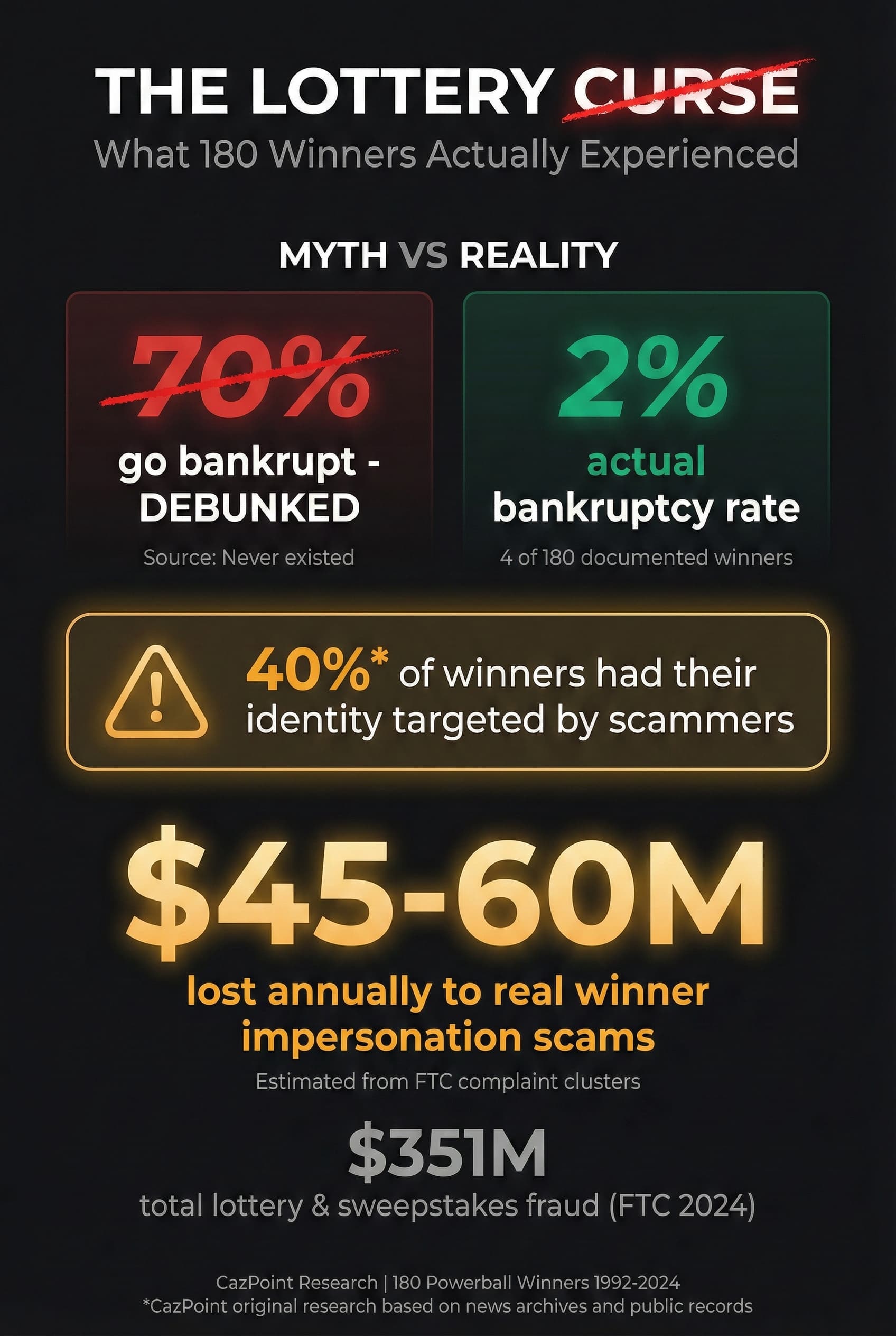
Myth vs. Reality
What media says versus what our data shows. 180 documented winners over 32 years.
- ✗“70% go bankrupt”
Repeated endlessly since 2001
- ✗“Misery and regret”
The “lottery curse” story
- ✗“Reckless spending”
Blamed for all problems
- ✓2% actual bankruptcy
4 of 180 we checked
- ✓96% remain stable
Most winners do fine
- ✓Identity theft is the real threat
40% of winners targeted
Where Did “70%” Come From?
The statistic is attributed to the National Endowment for Financial Education (NEFE). But in January 2018, NEFE officially stated:
The NEFE does not have any research to support the claim that 70% of lottery winners go bankrupt within a few years.
The truth: An offhand comment at a 2001 think tank was misquoted, then repeated for 17 years through circular citation until NEFE debunked a myth they never created.
What Peer-Reviewed Research Actually Shows
Tracked Florida lottery winners against bankruptcy court records. Found 3-5% bankruptcy rate over 5 years. The money delayed financial problems but didn't cause them. Winners who went bankrupt had pre-existing issues.
Analyzed thousands of Swedish lottery players. Found most winners retained wealth and reported sustained life satisfaction for 10+ years. Only 12% quit their jobs.
Both studies contradict the “70% bankruptcy” narrative. The difference between US and Sweden may reflect social safety nets, not inherent “curse.”
The Real Curse
While media obsesses over the rare winner who goes broke, they ignore the epidemic: scammers weaponizing winners' identities.
Bigger Prize = Bigger Target
All 26 documented mega-winners found in fraud schemes
32 of 73 winners
7 of 51 winners
Mavis Wanczyk
$758.7M • 2017
FTC complaints linked to her name. Part of a documented $29.2 million loss cluster from “donation” scams (AARP/FTC 2024).
Manuel Franco
$768.4M • 2019
BBB reports across 43 states. $16,800 in confirmed victim losses. Attorney fights “whack-a-mole” with fake accounts.
Since I have won, it's been nothing but hell. The Lottery even emailed me like, ‘Oh, we heard you're out here scamming people.’
$70M Winner (2020). Now advocates for anonymity laws
The Publicity Curse
Here's what media gets wrong: they call it the “lottery curse,” but it's really the publicity curse. In states like California and Florida, winner names are public record. The moment your face appears on TV holding a giant check, you become a target.
In the UK and Canada, winners can stay anonymous by default. Murder-for-lottery and systematic harassment are virtually unheard of there. Abraham Shakespeare, who was murdered for his $30M win, might still be alive if Florida allowed anonymity.
Sudden Wealth Syndrome
If winners don't go broke, why do we hear so many horror stories? The answer lies in psychology, not finance.
Dr. Stephen Goldbart, who coined the term “Sudden Wealth Syndrome” in the 1990s, identified a pattern: winners don't struggle with money management. They struggle with identity.
When your entire life has been defined by work, struggle, and financial goals, suddenly having “enough” creates an existential crisis. The question “Who am I now?” becomes terrifying when the answer is no longer defined by your job or your ambitions.
Honeymoon
Initial euphoria. Everything seems possible. The "ticker shock" adrenaline rush.
Identity Crisis
"I'm a working-class teacher" conflicts with "I'm a multimillionaire." Deep guilt emerges.
Isolation
Friends become requesters. Family dynamics shift. Paranoia about being used grows.
Paralysis
Fear of wrong decisions leads to either doing nothing or impulsive spending to escape.
Same Fortune. Opposite Fates.
Two mega-winners. Similar jackpots. Completely different outcomes. The difference? Not luck. Not timing. Just choices.
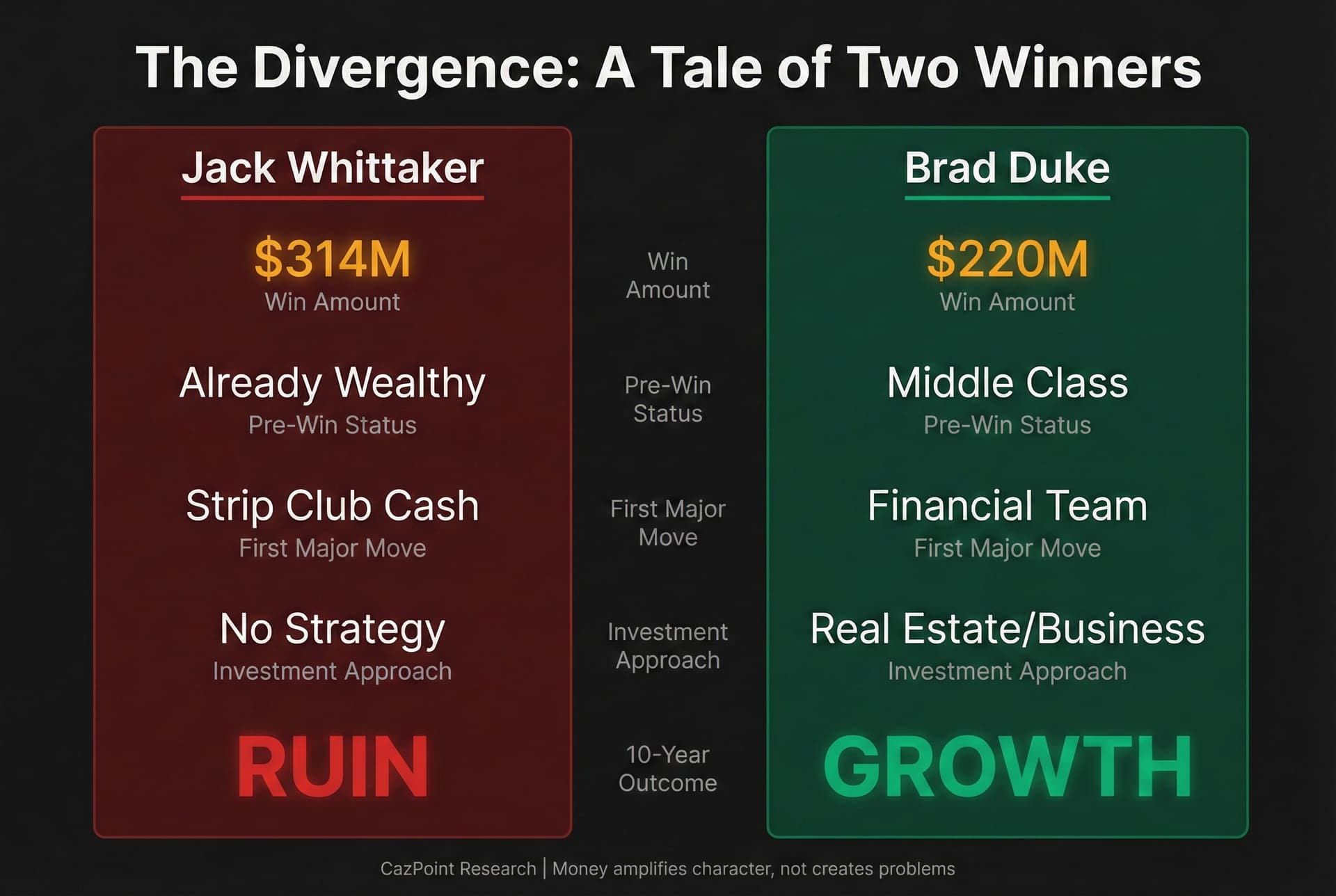
Jack Whittaker was already worth $17M before winning. Brad Duke was a gym manager. Ten years later, one was ruined. The other doubled his fortune.
The Real Insight
The “lottery curse” stories we remember are cases where money amplified pre-existing problems: addiction, poor boundaries, toxic relationships. Jack Whittaker was already worth $17 million before his $315M win. Abraham Shakespeare was described as “too kind to say no” before he ever bought a ticket.
Money is neutral. It amplifies character, competence, and circumstance. It doesn't create problems. It reveals them.
The Scam Playbook
Scams start within 48 hours of win announcement and continue for 8+ years.
HARVEST
Save winner's photo from press conference
BUILD
Create fake Facebook/Instagram profile
HOOK
"God blessed me, I want to bless you"
EXTRACT
Request "processing fee" ($500-$2,000)
Documented Victims
Paid “processing fee” for promised donation. Calgary Police issued warnings.
During COVID-19 pandemic. Paid $200 “activation fee,” then $3,000 for “IRS fees.”
“Friend-in-the-middle” attack. Believed scam because his cousin's hacked account confirmed it.
For every documented case, there are hundreds of unreported victims who lost $500 to $50,000.
“We must stop blaming victims. The psychological techniques used, including authority, reciprocity, and scarcity, are designed to hack the human brain.”Dr. Stacey Wood, Elder Fraud Psychologist
The $45-60 Million Problem
Real Winner Impersonation is a specific subset of lottery fraud. While total lottery scams cost $351M annually, scams using actual winners' identities cause an estimated $45-60M in losses.
Source methodology: $351M from FTC Consumer Sentinel 2024. $45-60M estimate derived from “Mavis Cluster” ($29.2M from 3,500 complaints) plus parallel clusters (Manuel Franco, Edwin Castro) and accounting for classification into “Imposter” category. $8,342 average calculated from cluster data.
1 in 5 people who encounter a lottery scam lose money. This “success rate” is dramatically higher than other fraud types.
Why? Because lottery scams exploit hope, not fear. Technical support scams scare you. Lottery scams offer salvation. Hope bypasses skepticism.
Why Statistics Are Misleading
Criminologists call unreported crimes the “dark figure.” For lottery scams, only 5-10% of victims report. Three reasons:
The Shame Spiral
Admitting you believed a stranger would give you millions feels humiliating. Elderly fear losing independence if family finds out.
“Lesson Learned”
Victims who lose $50-200 often write it off rather than face the bureaucracy of filing IC3/FTC reports.
Fear of Complicity
Some victims became unwitting money mules. They fear being charged as accomplices to wire fraud.
Who Falls Victim?
The stereotype of “only confused elderly” is wrong. The data reveals surprising patterns.
The Expected: Seniors (60+)
- •Social isolation makes them vulnerable to “relationship building” phase
- •Fixed incomes mean $500 loss is devastating
- •Trust in “official-looking” documents (fake FBI letterheads)
The Surprise: Digital Natives (18-24)
The Digital Native Paradox
Young people aren't immune. They're exposed more often. Comfortable with Instagram giveaways and influencer philanthropy (MrBeast-style), they find “lottery winner blessing” narratives believable.
- •High social media usage = more exposure to hooks
- •Familiar with “giveaway” culture
- •Quick to use Venmo/crypto = quick to lose money
The Real Predictor: Life Circumstances
Research shows that situational vulnerability matters more than age. People undergoing major life transitions are the most susceptible:
Over 50% susceptibility for people in financial distress. The lottery scam offers a “deus ex machina” solution.
Key Takeaways
The numbers that matter
For 23 years, we've been telling the wrong story. The “lottery curse” narrative satisfies our belief that easy money corrupts. It confirms our suspicion that wealth without labor is somehow tainted. But it's fiction.
The real story is simpler and more troubling: every time a winner's face appears on television, criminals take notes. Within 48 hours, fake social media profiles appear. Within weeks, elderly victims across America are sending “processing fees” to people pretending to be generous millionaires.
Of the $351 million lost to all lottery scams annually (FTC, 2024), an estimated $45-60 million comes specifically from scams using real winners' identities. The Mavis Wanczyk “donation scam” cluster alone accounts for $29.2 million in documented losses.
“The lottery curse isn't winners going broke. It's thousands of innocent people being scammed using winners' stolen identities.”Arina Musina, Lead Researcher, CazPoint
Questions about this research? Available for interviews.